
Not all water damage is created equal, and the difference matters more than most homeowners realize — both for your health and for how the cleanup actually has to happen.
The Three Categories, in Plain Language
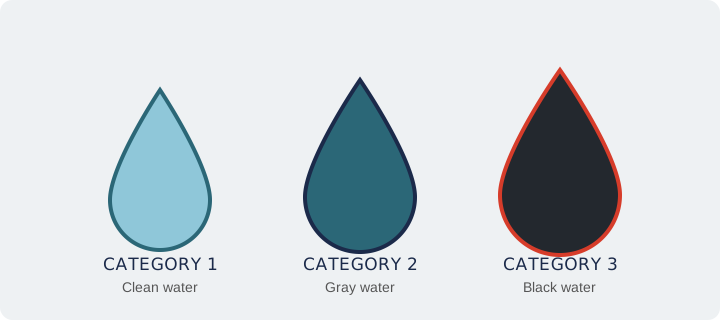
Restoration professionals classify water damage into three categories, and the category determines everything about how a job gets handled.
Category 1 — Clean water. Comes from a sanitary source: a supply line, a broken appliance hose, rainwater. It poses no immediate health risk, though it can still cause real structural damage if left untreated, and it can degrade into Category 2 if it sits too long.
Category 2 — Gray water. Contains some contamination — think washing machine overflow, dishwasher discharge, or a toilet overflow with urine but no feces. It can cause illness if ingested or if it contacts broken skin, so it requires more caution than clean water, but it's not the most severe category.
Category 3 — Black water. This is the one that requires real caution. It's grossly contaminated water containing pathogens, bacteria, and potentially dangerous organic matter. Sewage backups, flooding from rivers or storm surge, and water that's been sitting long enough to grow bacteria all fall into this category.
Why Black Water is Different
With Category 3 water, the goal isn't drying — it's removal. Porous materials that black water has touched — drywall, carpet, insulation, upholstered furniture — generally can't be cleaned and dried safely. They have to be removed and replaced, because the contamination goes deeper than surface cleaning can reach. This is a meaningful difference from a clean-water pipe burst, where drying in place is often enough.
Anyone in the affected area should avoid direct contact with the water — no wading through it, no letting pets or kids near it — until it's been professionally addressed. Category 3 cleanup typically requires personal protective equipment that goes well beyond what a homeowner would have on hand.
Common Sources of Black Water in Ohio Homes
- Sewage backups, especially in older homes with combined sewer systems that can overflow during heavy rain
- River or storm flooding entering a basement from outside
- Water that's been standing for several days, even if it started out clean — bacteria growth reclassifies it over time
- Groundwater intrusion carrying soil contaminants through foundation cracks
What This Means for Your Cleanup Timeline
Because Category 3 water requires removal rather than drying, these jobs are almost always more involved — and more expensive — than a clean-water event of the same size. It's also why waiting to call is riskier here than with any other water category: the longer black water sits, the more of your home's materials cross the line from "salvageable" to "has to go."
The Official Definition, and Why It's Written That Way
The IICRC S500 standard defines Category 3 water as grossly contaminated, capable of causing significant adverse health reactions if contacted or consumed, and it explicitly lists sewage, seawater flooding, and rising water from rivers or streams as examples — regardless of how clean that water might visually appear. This matters because homeowners often assume "black water" means visibly dirty or discolored water, but the classification is about the source and contamination risk, not appearance. Clear-looking river floodwater is still Category 3, because it's carrying agricultural runoff, bacteria, and whatever else it picked up on its way to your basement.
The Category Can Change Over Time — In Both Directions Practically
Water damage classification isn't always fixed at the moment of the incident. Clean, Category 1 water that sits untreated for roughly 24 to 48 hours can develop bacterial growth and effectively become Category 2, simply from sitting in a warm, damp environment in contact with organic materials like carpet padding and drywall paper. This is part of why restoration professionals treat speed as a genuine variable in cost and health risk, not just a convenience factor — a fast response can keep a clean-water event clean, while delay can turn it into a more serious, more expensive classification.
Protective Equipment Professionals Actually Use
Category 3 cleanup typically involves full personal protective equipment: waterproof coveralls, rubber boots, nitrile or heavier gloves, eye protection, and often a respirator rated for biological contaminants, particularly in enclosed spaces like basements with limited ventilation. This is a meaningfully different level of protection than what's reasonable to expect a homeowner to have on hand, which is the practical reason DIY cleanup of genuine black water isn't a reasonable cost-saving measure — the equipment gap alone makes it a real health risk, separate from the question of whether the cleanup would even be effective.
What Happens to Contaminated Belongings
Porous personal items that contacted Category 3 water — upholstered furniture, mattresses, stuffed toys, books, and similar materials — generally cannot be safely disinfected and are typically recommended for disposal rather than cleaning, even if they don't look damaged. Non-porous or semi-porous items — solid wood furniture, some plastics, metal — can often be cleaned and disinfected, though this should be done by someone trained in the process rather than with household cleaning products, which aren't formulated for this level of contamination.
If you're dealing with black water — a sewage backup, flooding, or standing water that's been there more than a couple of days — ClearFlow Restoration's dispatch line connects you to licensed, IICRC-certified crews trained for Category 3 cleanup, 24/7.
📞 Call (419) 588-0112